Poney Jade Restaurant
Cart/Kiosk @ IMM Building
SGD29.95 for two pieces
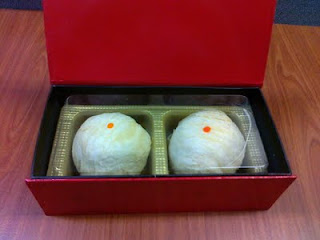 The Original Ex-Crown Prince Flaky
Teochew ‘Oor Nee’ Mooncake
with Single Egg Yolk
I am now enjoying my holidays in Scandinavia, north of Europe, taking in the beautiful scenes of autumn, the colors and the falling leaves. Have you ever wondered why leaves fall during autumn? Many people believe tree leaves fall and die during the autumn season because of weather changes, but studies have shown the real reason for the fall is drought. This is because the primary function of leaves is photosynthesis, and photosynthesis requires the use of water, carbon dioxide and light to create food in the leaves to generate organic compounds and oxygen. In order to induce a suction force, the leaves will need to constantly sweat, and in winter season shed them so as not to get dried. Daylight, however, gets shorter during fall and causes the leaves to suffer thirst because of the reducing absorption of water with the shrinking daylight. This means even when trees live in wet climate with abundant snowfall and rainfall or even when in the warmest of autumn seasons, the trees will still lose their leaves, triggered by the shorten length of daylight.
Many changes occur in the leaves before they finally fall from the branch. According to Joe Lamp’L of DIY Network who wrote an article on ‘Why do leaves fall in autumn?’ at ScrippsNews.com, changing colors of leaves during fall is part of an important and complicated process known as abscission which ends in the leaves being shed at the end of each growing season. The trees, in protecting themselves, purge diseased, damaged or dead leaves, while they seal the point where the petiole connects to it. As the climate and light conditions of autumn evolve, tree hormones change as well, the most notable of which is auxin, a hormone in trees that promotes root formation and bud growth. The balance of auxin levels between leaves and branches is the key to determining if and when the leaves drop.
During the active growing season, production rates of auxin in leaves are consistent with those in other parts of the tree. As long as these rates are steady, the cells of the abscission layer remain connected, which in turn, keeps leaves attached. However, as days shorten and temperatures cool, auxin production in leaves starts to decrease. As a result, fracture lines develop at the base of the leaf petioles and scarring builds up at the same point to form a protective barrier. Eventually, it's just a matter of time before wind or rain provides that last nudge and the leaves are released, at least for most trees.
Although leaves falling in autumn are a predictable event, leaf drop is not only seasonal. Trees can lose leaves for other reasons as well, such as drought and other physical or environmental stresses. So this autumn, enjoy and savor the brilliant display of color, but be thankful always for the deciduous trees, because in spite of all the leaves on the ground, they are doing more good than you can imagine, because these leaves provide vital organic matter to the soil, returning to the soil nutrients and building structure and water holding capacity.
Source of Information: Why do leaves fall in autumn?
Why autumn leaves are red in America and yellow in Europe
August 14, 2009

WASHINGTON -- Scientists are studying environmental conditions 35 million years ago to solve the mystery that why autumn leaves are red in America and yellow in Europe.
The green of a tree's leaves is from the larger proportion of the chlorophyll pigment in the leaves.
The change in color to red or yellow as autumn approaches is not the result of the leaves' dying, but of a series of processes - which differ between the red and yellow autumn leaves.
When the green chlorophyll in leaves diminishes, the yellow pigments that already exist become dominant and give their color to the leaves.
Red autumn leaves result from a different process: As the chlorophyll diminishes, a red pigment, anthocyanin, which was not previously present, is produced in the leaf.
These facts were only recently discovered and led to a surge of research studies attempting to explain why trees expend resources on creating red pigments just as they are about to shed their leaves.
Explanations that have been offered vary and there is no agreement on this as of yet.
According to the theory provided by Professor Simcha Lev-Yadun of the Department of Science Education- Biology at the University of Haifa-Oranim and Professor Jarmo Holopainen of the University of Kuopio in Finland, until 35 million years ago, large areas of the globe were covered with evergreen jungles or forests composed of tropical trees.
During this phase, a series of ice ages and dry spells transpired and many tree species evolved to become deciduous.
Many of these trees also began an evolutionary process of producing red deciduous leaves in order to ward off insects.
In North America, as in East Asia, north-to-south mountain chains enabled plant and animal 'migration' to the south or north with the advance and retreat of the ice according to the climatic fluctuations. Along with them migrated their insect 'enemies' too.
Thus, the war for survival continued there uninterrupted.
In Europe, on the other hand, the mountains - the Alps and their lateral branches - reach from east to west, and therefore no protected areas were created.
Many tree species that did not survive the severe cold died, and with them the insects that depended on them for survival.
At the end of the repeated ice ages, most tree species that had survived in Europe had no need to cope with many of the insects that had become extinct, and therefore no longer had to expend efforts on producing red warning leaves, thus becoming yellow in color over time.
 The Original Ex-Crown Prince Flaky

